CAGR CALCULATOR
CAGR Calculator
What Is a CAGR Calculator?
CAGR Calculator helps you calculate the Compound Annual Growth Rate (CAGR) a key investment metric used to measure the average annual growth rate of an investment over multiple years.
Whether you are tracking stock performance, mutual funds, real estate value growth, or business revenue growth, the CAGR Calculator shows you how your investment has grown on average each year.
What CAGR Tells You
CAGR represents the smoothed annual growth rate from the beginning value to the ending value over a specified period of time assuming the profits were reinvested every year.
Unlike simple averages, CAGR accounts for compounding, making it one of the most accurate ways to measure multi-year investment performance.
How to Use the CAGR Calculator
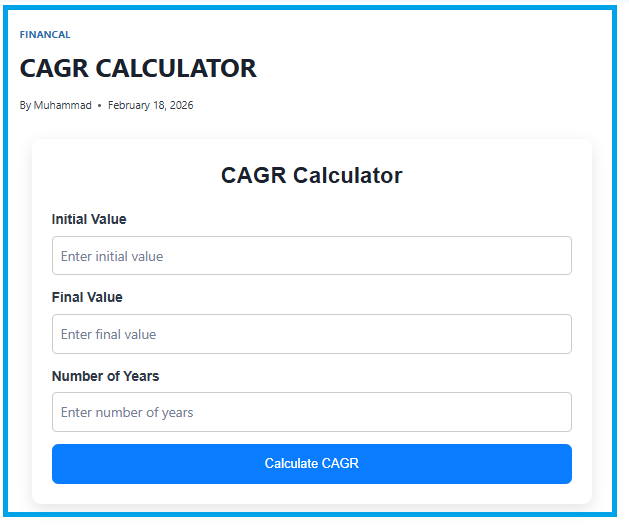
Using the CAGR Calculator couldn’t be easier! Follow these simple steps:
Enter the Beginning Value
Enter the initial investment or starting value of the asset.
Enter the Ending Value
Enter the final value of the investment at the end of the period.
Enter the Number of Years
Input the total number of years between the beginning and ending values.
Click the Calculate button
The CAGR Calculator will instantly show:
The CAGR percentage
A growth rate that shows yearly performance
It’s fast, intuitive, and accurate no finance degree needed!
CAGR Formula Explained
The CAGR Calculator uses this standard formula:
Formula
CAGR = (Ending Value / Beginning Value)^(1 / Number of Years) − 1
Formula Breakdown
- Ending Value: Final amount of the investment
- Beginning Value: Initial amount invested
- Number of Years: Time period the investment was held
- Result: Annual growth rate expressed as a percentage
Example
Beginning Value: $10,000
Ending Value: $20,000
Time: 5 years
Plug into the formula:
CAGR = (20,000 / 10,000)^(1/5) − 1
     ≈ 0.1487 or 14.87%
This means your investment grew by an average of 14.87% per year.
Why Use a CAGR Calculator?
Shows true annual return
CAGR reflects actual growth considering compounding.
Ideal for comparing investments
Compare stocks, funds, and portfolios with a standard yearly growth rate.
Removes volatility noise
Annual returns can be misleading CAGR smooths them out.
Great for financial planning
Use it to estimate future value and set realistic performance goals.
Works for any asset
Stocks, properties, businesses, crypto, or savings accounts.
Compound Growth vs CAG
Unlike simple averages, CAGR assumes your gains are reinvested yearly, giving you a realistic picture of how your investment actually performed over time.
For investments with fluctuating yearly returns, CAGR gives a more meaningful picture.
FAQs about CAGR CALCULATOR
Q1: What is Compound Annual Growth Rate (CAGR)?
Ans: CAGR is the average annual growth rate of an investment over a defined period, assuming profits are reinvested.
Q2: Why is CAGR useful?
Ans: CAGR gives a standardized annual percentage so you can compare performance of different investments over time.
Q3: Does CAGR show real daily fluctuations?
Ans: No CAGR smooths out volatility. It does not show year-by-year highs and lows.
Q4: Can I use CAGR for real estate?
Ans: Absolutely. CAGR is commonly used to measure appreciation of property values over many years.
Q5: Do I need annual return data to use this calculator?
Ans: No this calculator only needs the beginning value, ending value, and the number of years.
Q6: Who Can Benefit from the CAGR Calculator?
Ans: This tool is perfect for:
- Investors
- Financial planners
- Real estate owners
- Business analysts
- Students and educators
Whether you’re planning your portfolio or evaluating past performance, the CAGR Calculator gives you reliable annual growth figures instantly.
Conclusion:
CAGR Calculator is your go-to tool for measuring long-term investment performance. It takes your beginning and ending values and tells you how strongly (or weakly) your money has grown every year.
Whether you are budgeting, investing, or planning for the future, this calculator gives you clear growth insights you can trust.