
Net Present Value Calculator
Net Present Value (NPV) Calculator
NPV Analysis
What Is a Net Present Value Calculator?
A Net Present Value Calculator helps you evaluate the profitability of an investment by calculating the difference between the value of cash inflows and cash outflows over time — taking into account the time value of money.
NPV is widely used in finance, capital budgeting, real estate, investment analysis, and business planning.
If the NPV is positive, the investment may be considered profitable. If it’s negative, the investment may lose value over time.
Why is Net Present Value Important?
Net Present Value gives you:
A dollar value that represents true investment worth
A way to compare investment alternatives
Insight into long-term financial performance
A foundation for capital budgeting decisions
Instead of assuming future money has the same value as today, NPV discounts future cash flows based on a selected rate, making your analysis more realistic and accurate.
How to Use the Net Present Value Calculator
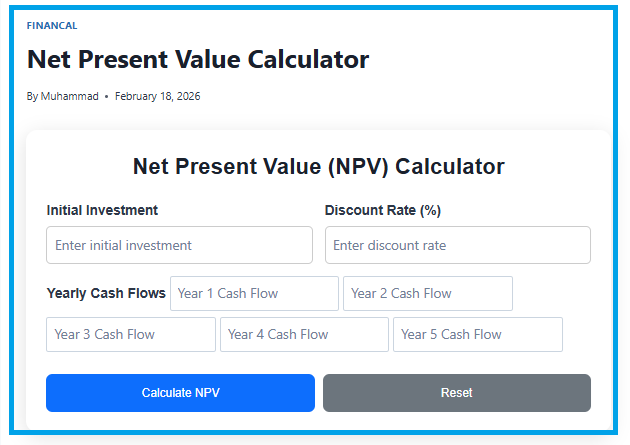
Using this calculator is easy:
Step 1 Enter Initial Investment (Cost)
This is the amount you invest at the beginning (usually a negative cash flow).
Step 2 Enter Discount Rate (%)
Input the minimum required rate of return or cost of capital.
Step 3 Enter Future Cash Flows
Enter the expected gains (positive values) or losses (negative values) for each future period (year 1, year 2, etc.).
Step 4 Click Calculate
The calculator instantly shows:
The Net Present Value (NPV)
Interpretation of whether the investment is worthwhile
That’s it no financial math needed!
Net Present Value Formula Explained
Net Present Value (NPV) is calculated as:
NPV = Σ [ Ct / (1 + r)^t ] − C0
Where:
• Ct = Cash flow at time t
• r = Discount rate
• t = Time period (usually in years)
• C0 = Initial investment
Each future cash flow (Ct) is discounted back to today’s value using the discount rate, then all cash flows are summed up and the initial cost is subtracted.
Example Calculation
Suppose:
- Initial Investment: –$10,000
- Discount Rate: 8%
- Year 1 Cash Flow: $4,000
- Year 2 Cash Flow: $5,000
- Year 3 Cash Flow: $6,000
NPV =
(4000 / 1.08^1) + (5000 / 1.08^2) + (6000 / 1.08^3) − 10000
≈ 3703.70 + 4282.57 + 4769.10 − 10000
≈ $274.37 (positive NPV)
Interpretation:
A positive NPV means the investment is likely to generate value above the cost of capital.
How to Interpret NPV
Positive NPV
Indicates projected earnings (discounted to present value) exceed costs Good investment.
Zero NPV
Investment breakeven returns match the discount rate.
Negative NPV
Investment likely loses value Proceed with caution.
Discount Rate What It Means
The discount rate reflects the required return or opportunity cost of capital. A higher rate decreases the present value of future cash flows raising your risk threshold.
Discount rate options often include:
Cost of capital
Expected return rate
Risk-adjusted return expectation
FAQs about Net Present Value Calculator
Q1: What is Net Present Value (NPV)?
Ans: NPV is a method to evaluate the profitability of an investment by discounting future cash flows to present value using a specific discount rate.
Q2: Why is NPV useful?
Ans: NPV accounts for the time value of money and helps make informed investment decisions by comparing future benefits to current costs.
Q3:Is a higher NPV better?
Ans: Yes a higher (more positive) NPV generally means the investment is more attractive.
Q4: Can NPV be negative?
Ans: Yes negative NPV means projected returns don’t cover the investment cost at the chosen discount rate.
Q5: Should I use NPV with IRR?
Ans: Yes NPV and Internal Rate of Return (IRR) are often used together to evaluate investments.
Conclusion:
Net Present Value Calculator is an essential finance tool that helps you assess the real value of future cash flows by accounting for the time value of money. Whether you’re evaluating business projects, investment opportunities, or real estate, this calculator provides fast, reliable insights to guide better financial decisions.