
Payback Period Calculator
Payback Period Calculator
Payback Period Analysis
What Is a Payback Period Calculator?
Payback Period Calculator determines the amount of time required for an investment to recoup its initial cost from the cash inflows it generates over time.
This is one of the most widely used financial metrics for evaluating business projects, capital budgeting decisions, and investment opportunities.
If the payback period is short, an investment is generally seen as lower risk and more attractive.
Why the Payback Period Matters
The payback period helps you:
See how quickly you recover your initial investment
Compare investment options easily
Make informed business or personal finance decisions
Assess liquidity risk Quickly screen projects before deeper analysis
It is especially useful when cash flow timing is important or when you want a simple, intuitive view of investment risk.
How to Use the Payback Period Calculator
Using this calculator is fast and straightforward:
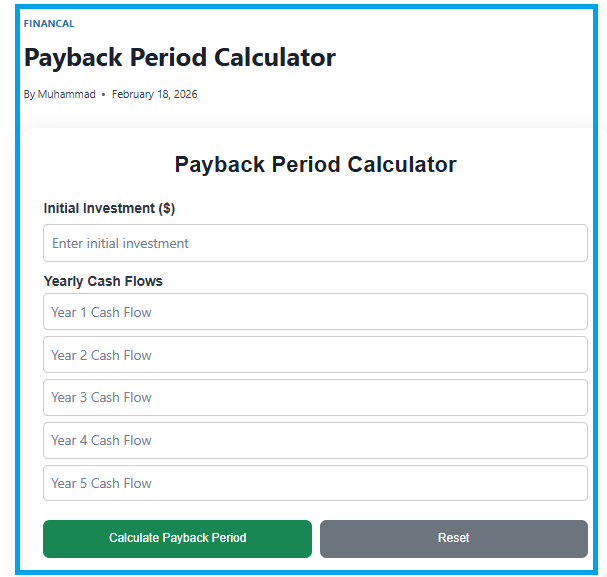
Step 1 Enter the Initial Investment
Enter the upfront cost of the project or investment (usually a positive number representing cash outflow).
Step 2 Enter the Future Cash Inflows
Add the expected net cash flows for each period (typically years).
Year 1
Year 2
Year 3
… and so on.
Step 3 Click “Calculate”
The tool instantly shows the payback period the time when cumulative inflows equal the initial cost.
This makes it easy to determine how long it will take to break even from the investment.
Payback Period Formula Explained
The basic idea of the payback period is:
Payback Period = Time needed for cumulative cash inflows to equal initial investment
If cash flows are equal each year:
Payback Period = Initial Investment ÷ Annual Cash Flow
But if cash flows vary by year, the calculator adds up each period’s cash flow until the total reaches your starting cost.
This tool automatically performs that calculation for you.
Example Calculation
Say you are evaluating a project with:
- Initial Investment: $50,000
- Year 1 Cash Inflow: $15,000
- Year 2 Cash Inflow: $18,000
- Year 3 Cash Inflow: $20,000
- Year 4 Cash Inflow: $22,000
Cumulative cash flows:
- End of Year 1: $15,000
- End of Year 2: $33,000
- End of Year 3: $53,000
Since your initial cost ($50,000) is recovered sometime in Year 3, the payback period is between 2 and 3 years.
You could report it as ~2.8 years if partial years are included.
How to Interpret the Result
Shorter Payback Period
Means you recover cost quickly often seen as less risky.
Longer Payback Period
Indicates slower recovery usually higher risk.
No Payback
If cumulative cash inflows never reach the initial investment, the payback period is not attained — suggesting the project may not be viable.
FAQs about Payback Period Calculator
Q1: What is the payback period?
Ans: The payback period is the time it takes for an investment’s cash inflows to recover its initial cost.
Q2: Does this calculator consider profit after recovery?
Ans: No this metric only addresses how long it takes to recover cost. It doesn’t measure total profitability.
Q3: Does payback period consider the time value of money?
Ans: Traditional payback period does not account for the time value of money. Other metrics like NPV or IRR do that.
Q4:Is a shorter payback period always better?
Ans: Generally yes shorter payback equates to faster cost recovery. However, payback period doesn’t reflect long-term profits.
Q5: When should I use the payback period?
Ans: Use it when cash flow timing and cost recovery speed are priorities, such as in startup budgeting or short-term projects.
Conclusion:
The Payback Period Calculator is a valuable tool for quickly determining how long your investment will take to break even. With simple inputs and instant results, you can assess risk, compare investment options, and make smarter business decisions without complex calculations.