
Price Elasticity of Demand Calculator
Price Elasticity of Demand (PED) Calculator
What Is the Price Elasticity of Demand Calculator?
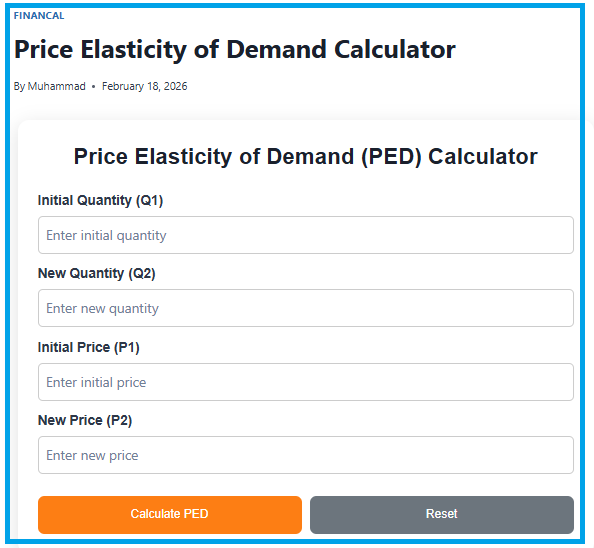
Price Elasticity of Demand Calculator helps you determine the responsiveness of demand for a product or service when its price changes.
Price elasticity of demand (PED) is a key economic concept used in business, marketing, retail pricing, and economic analysis to understand consumer behavior.
This tool shows whether demand is:
Elastic (very responsive to price change)
Inelastic (less responsive to price change)
Unit elastic (proportional response)
Why Price Elasticity of Demand Matters
Understanding price elasticity helps you:
Set optimal prices
Predict how demand will change with price adjustments
Estimate revenue impact from price changes
Compare products by sensitivity
Improve pricing and marketing decisions
This is especially useful for:
Retailers
Business owners
Economists
Students and researchers
How to Use the Price Elasticity of Demand Calculator
Using this calculator is simple and intuitive:
Step 1 Enter the Original Price (P1)
This is the initial price of the product before the change.
Step 2 Enter the New Price (P2)
This is the updated price after the change.
Step 3 Enter the Original Quantity (Q1)
The amount sold at the original price.
Step 4 Enter the New Quantity (Q2)
The amount sold at the new price.
Step 5 Click Calculate
Instantly find the price elasticity of demand value and its interpretation.
Price Elasticity of Demand Formula Explained
Price elasticity of demand is calculated as:
Price Elasticity of Demand (PED) =
(% Change in Quantity Demanded) ÷ (% Change in Price)
or expanded:
PED =
[(Q2 − Q1) ÷ Q1] ÷ [(P2 − P1) ÷ P1]
Where:
- Q1 = original quantity demanded
- Q2 = new quantity demanded
- P1 = original price
- P2 = new price
The result measures the sensitivity of demand to changes in price.
How to Interpret the Result
Elastic Demand (PED < −1)
Demand changes more than proportionally to price changes.
Consumers are very responsive.
Inelastic Demand (−1 < PED < 0)
Demand changes less than proportionally to price changes.
Consumers are less responsive.
Unit Elastic (PED = −1)
Demand changes proportionally to price changes.
Positive PED (Rare)
May indicate Veblen or Giffen goods, where demand increases with price uncommon in traditional markets.
Example Calculation
Suppose:
- Original price (P1) = $10
- New price (P2) = $8
- Original quantity (Q1) = 1,000 units
- New quantity (Q2) = 1,400 units
Then:
% Change in Quantity = (1,400 − 1,000) ÷ 1,000 = 0.4
% Change in Price = (8 − 10) ÷ 10 = −0.2  PED = 0.4 ÷ (−0.2) = −2.0
Interpretation:
PED = −2.0 → Demand is elastic. Consumers are very responsive to the price change.
Benefits of Using the Price Elasticity of Demand Calculator
Helps optimize pricing strategies
Provides insight into consumer purchasing behavior
Identifies sensitivity of demand across products
Aids in forecasting revenue changes
Valuable for market analysis and economics education
Instantly delivers accurate results without manual calculations
FAQs about Price Elasticity of Demand Calculator
Q1: What is price elasticity of demand?
Ans: Price elasticity of demand measures how the quantity demanded of a product responds to changes in its price.
Q2: Why is elasticity negative?
Ans: Negative values reflect the inverse relationship between price and demand as price increases, demand usually decreases.
Q3: What does a high elasticity value mean?
Ans: A high absolute elasticity (e.g., |PED| > 1) means consumers are very responsive to price changes.
Q4: Is zero elasticity possible?
Ans: Yes zero elasticity means quantity demanded does not change with price changes.
Q5: Can price elasticity be positive?
Ans: Yes. In rare cases (e.g., Veblen and Giffen goods), consumers may buy more as prices rise, resulting in positive elasticity.
Conclusion:
Price Elasticity of Demand Calculator is a powerful tool for measuring how price changes affect demand for a product. It helps businesses, economists, and analysts understand consumer behavior and make smarter pricing and strategy decisions.
Use this tool to gain insight into demand sensitivity, compare products, and forecast how price changes could influence revenue and sales.