
Price Elasticity of Supply Calculator
Price Elasticity of Supply (PES) Calculator
What Is the Price Elasticity of Supply Calculator?
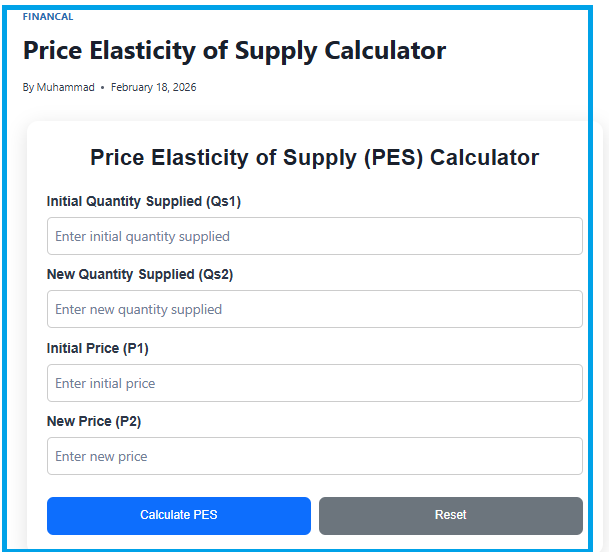
Price Elasticity of Supply Calculator helps you measure how much the quantity supplied of a product changes in response to a change in price.
Price elasticity of supply (PES) is a key economic metric that shows:
How responsive producers are to price changes
Whether supply is elastic, inelastic, or unit elastic
How changes in price may affect market supply levels
This tool is useful for economists, business owners, market analysts, and students.
Why Price Elasticity of Supply Matters
Understanding elasticity of supply helps you:
Predict producer behavior
Set better production and pricing strategies
Estimate supply-side responsiveness
Analyze market equilibrium changes
Make data-backed strategic decisions
It’s especially useful in:
Manufacturing
Retail and wholesale
Economic forecasting
Academic research
How to Use the Price Elasticity of Supply Calculator
Using this calculator is simple:
- Enter Original Price (P1)
The initial price per unit before the change. - Enter New Price (P2)
The updated price after the change. - Enter Original Quantity Supplied (Q1)
Amount of units supplied at the original price. - Enter New Quantity Supplied (Q2)
Amount of units supplied after the price change. - Click Calculate
The calculator will show:
Price elasticity of supply
Interpretation of elasticity (elastic, inelastic, etc.)
Price Elasticity of Supply Formula Explained
The standard formula used:
Price Elasticity of Supply (PES) =
(% Change in Quantity Supplied) ÷ (% Change in Price)
Expanded:
PES =
[(Q2 − Q1) ÷ Q1] ÷ [(P2 − P1) ÷ P1]
Where:
- Q1 = original quantity supplied
- Q2 = new quantity supplied
- P1 = original price
- P2 = new price
This formula measures how much supply changes relative to price.
How to Interpret the Result
PES > 1 Elastic Supply
Suppliers are very responsive to price changes.
A small increase in price leads to larger increases in quantity supplied.
PES = 1 Unit Elastic
Supply changes proportionally to price changes.
PES < 1 Inelastic Supply
Supply is not very responsive to price changes.
Producers cannot easily change output levels in response to price changes.
Example Calculation
Suppose:
- Original price (P1) = $10
- New price (P2) = $12
- Original quantity supplied (Q1) = 1,000 units
- New quantity supplied (Q2) = 1,200 units
Then:
% Change in Quantity Supplied = (1,200 − 1,000)/1,000 = 0.2
% Change in Price = (12 − 10)/10 = 0.2PES = 0.2 ÷ 0.2 = 1.0
Interpretation:
PES = 1.0 → Unit elastic supply supply changed proportionally to price.
Benefits of Using the Price Elasticity of Supply Calculator
Fast, accurate elasticity measurement
Helps optimize production decisions
Easy comparison between products and markets
Provides insight into producer behavior
Useful in financial forecasting and planning
FAQs about Price Elasticity of Supply Calculator
Q1: What is price elasticity of supply?
Ans: Price elasticity of supply measures how much the quantity supplied changes when price changes.
Q2: Why is supply elasticity important?
Ans: It helps producers and policymakers understand how supply reacts to market conditions.
Q3: What does elastic supply mean?
Ans: Elastic supply means quantity supplied changes more than proportionally to price changes.
Q4: What does inelastic supply mean?
Ans: Inelastic supply means quantity supplied changes less than proportionally to price changes.
Q5: Can elasticity of supply be negative?
Ans: No supply elasticity is generally positive because supply usually increases as price increases.
Conclusion:
Price Elasticity of Supply Calculator is a valuable tool for understanding how price changes influence the quantity of goods suppliers are willing to produce and sell. By entering original and new price and quantity values, you get instant insight into supply responsiveness crucial for pricing strategy, market analysis, and economic planning.